
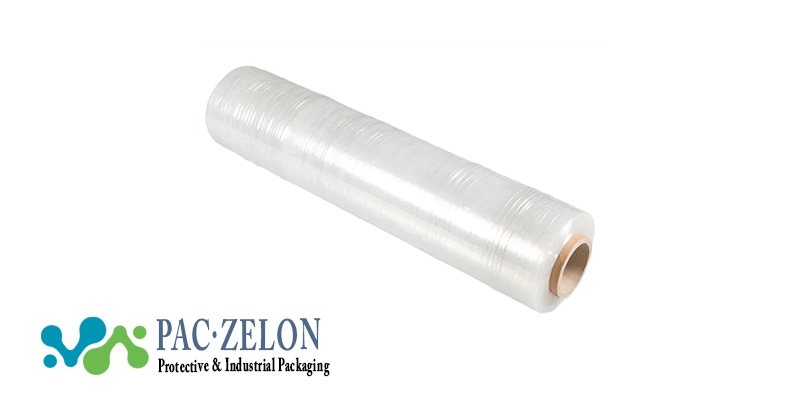
How to Choose Hand Stretch Film Thickness: A Practical Gauge Guide
-
 Calico Cat
- 7th July 2026

Why Stretch Film Gauge Matters
Gauge — measured in microns (μm) — determines how much force the film can absorb before tearing, how far it stretches before losing cling, and how many passes are needed to secure a load.
Two common assumptions cause problems:
Thicker is always better. Not true. Heavier gauge film costs more per roll and adds weight per wrap pass. On light loads, 23μm is overkill — you’re paying for puncture resistance you don’t need.
Thinner saves money. Also only partially true. Under-gauged film on a heavy or irregular load means more passes to achieve the same containment force — which cancels out the per-unit cost saving and adds wrapping time.
The goal is the minimum gauge that achieves secure load containment for your specific application. Everything above that minimum is cost without benefit.
Standard Hand Stretch Film Gauges and Their Applications
15μm — Light-duty, high-volume, cost-sensitive
The thinnest commonly stocked gauge. Used where load weight is low, stability isn’t a primary concern, and cost per wrap is the dominant factor.
Typical applications:
- Retail bundling and shelf-ready packaging
- Light parcel reinforcement in e-commerce fulfillment
- Bundling small components in manufacturing
- Wrapping individual boxed items rather than full pallets
Load weight guideline: Under 200kg, stable and uniform loads only.
What to watch for: 15μm tears more easily on rough surfaces and sharp corners. Not suitable for anything with irregular edges, protruding straps, or mixed-weight stacking.
18μm — General purpose, the most commonly stocked gauge
The default hand stretch film gauge for most warehouse and distribution operations. Covers a wide range of standard applications without the cost premium of thicker film.
Typical applications:
- Standard mixed-SKU pallet wrapping
- General warehouse and 3PL operations
- Distribution centers with consistent, stable loads
- Operations where wrapping speed and ease of use matter
Load weight guideline: 200–400kg on stable, uniform loads. Up to 500kg with additional wrap passes.
What to watch for: Marginal on heavy loads or anything with significant height-to-base ratio. If your team is consistently running more than 4–5 passes to feel secure, move to 20μm.
20μm — The step up for mixed or slightly irregular loads
A modest gauge increase that meaningfully improves puncture resistance and containment force. The right choice when 18μm works most of the time but fails on a portion of your loads.
Typical applications:
- Mixed pallets with varied weights and heights
- Light manufacturing — finished goods with some surface irregularity
- Operations that previously used 18μm but saw occasional film failure
- Export loads moving through multiple handling points
Load weight guideline: 300–600kg. Handles moderate irregularity in load shape.
What to watch for: The cost difference from 18μm is usually 10–15% per roll — worth it if it eliminates rewraps or film failures on a meaningful percentage of your output.
23μm — Heavy-duty standard
The threshold gauge for genuinely demanding manual wrapping applications. Where 20μm is marginal, 23μm holds. Used heavily in building materials, industrial manufacturing, and any environment where loads are heavy, irregular, or handled roughly.
Typical applications:
- Heavy pallets above 600kg
- Building materials — timber, tiles, piping, sheet goods
- Industrial components with protruding edges or uneven surfaces
- Cold chain / temperature-sensitive loads where film stress from condensation is a factor
- Loads that pass through multiple handlers in export or freight forwarding
Load weight guideline: 500kg and above. Suitable for loads up to 1,000kg+ with appropriate pass count.
What to watch for: At this gauge, wrapping fatigue for manual operators becomes a real consideration. If your team wraps high volumes at 23μm, consider whether a pre-stretched hand film or a machine wrapper would be a better long-term investment.
30μm — Specialist heavy-duty
Beyond the standard range. Used in applications where standard gauges consistently fail — extremely heavy loads, highly irregular surfaces, or environments with elevated mechanical stress on the film during transit.
Typical applications:
- Very heavy industrial loads (machinery, castings, heavy fabrications)
- Sharp-edged materials that would tear lighter gauges on contact
- Loads where film failure has caused documented freight damage claims
Load weight guideline: 800kg and above, or any load with edges or protrusions that consistently damage lighter film.
What to watch for: At 30μm, per-roll cost is significantly higher and roll weight makes manual application more physically demanding. Evaluate whether a lower-gauge metallocene film might achieve the same performance at lower cost — metallocene film’s higher elongation can match or exceed the puncture resistance of standard LLDPE at higher gauge.
How Regional Markets Approach Gauge Selection
Gauge preferences vary more than most buyers expect — often driven by legacy purchasing habits rather than load engineering.
North America The US market has historically used thicker gauges than equivalent applications in other markets — 20μm as a default where European operations would use 17–18μm. Pre-stretched hand film is also more widely adopted, particularly in 3PL and distribution environments where labor efficiency is closely tracked.
Europe More aggressive gauge optimization, driven by both cost pressure and sustainability targets. 17–18μm is a common default, with 15μm adopted for lighter applications. The EU push toward reduced plastic consumption has accelerated moves toward thinner high-performance films.
Southeast Asia and emerging markets 18–20μm dominates as a practical default. Price sensitivity is high, which tends to favor standard LLDPE at established gauges over thinner high-performance options — though this is shifting as larger manufacturers adopt more systematic packaging engineering.
Middle East and export-heavy markets Higher ambient temperatures affect film performance — heat reduces cling and can cause film to relax on pallets during storage. This pushes buyers toward slightly heavier gauges or films specifically formulated for high-temperature performance.
How to Choose the Right Gauge: A Decision Framework
If you’re evaluating gauge for the first time or troubleshooting film performance, work through these four variables:
1. Load weight The single most reliable predictor. Use the weight guidelines in the gauge descriptions above as your starting point.
2. Load shape and surface Uniform, smooth-surfaced loads tolerate thinner film better than irregular ones. If your loads have sharp edges, protruding straps, or significant variation in surface height, move up one gauge from what the weight guideline suggests.
3. Number of handling points A load that goes from your floor to one customer’s receiving dock has different film requirements than one that transfers through three freight handlers and a customs inspection. More handling = more stress on the film. Add half a gauge step for every additional major handling point.
4. Wrapping method and pass count More passes compensate for lighter gauge — but at the cost of operator time and total film consumption. If your team runs 6+ passes on every pallet to feel secure at a given gauge, you’re likely better off moving up one gauge and reducing pass count. Calculate: (cost per roll ÷ meters per roll) × meters per pallet at your current pass count vs. the same calculation at one gauge higher with fewer passes. The result is often closer than expected.
Recommended Starting Specs by Scenario
| Scenario | Recommended gauge | Width |
|---|---|---|
| Light retail / e-commerce parcels | 15μm | 200–300mm |
| General warehouse pallets | 18μm | 450–500mm |
| Mixed pallets, moderate irregularity | 20μm | 450–500mm |
| Heavy or irregular industrial loads | 23μm | 450–500mm |
| Very heavy / sharp-edged loads | 30μm | 500mm |
| Component bundling / in-process | 15–18μm | 50–150mm (mini) |
| Tamper-evident or UV-sensitive | 20–23μm | 450–500mm (black) |
FAQ
Does thicker film always mean stronger load containment?
Not directly. Containment force is a product of gauge, stretch ratio, and pass count. A thinner film applied at higher stretch with more passes can achieve the same or greater containment force as a thicker film applied loosely with fewer passes. That said, for manual wrapping where stretch consistency varies by operator, a slightly heavier gauge provides a more reliable floor on performance.
What’s the relationship between film thickness and cost efficiency?
The cost-per-pallet calculation needs to account for gauge, meters per roll, and passes per pallet — not just price per roll. A 23μm roll that secures a load in 3 passes may cost less per pallet than an 18μm roll that requires 5 passes on the same load. Run the math for your specific application rather than comparing roll prices directly.
Can I use one gauge for all my pallets?
Operationally appealing, but often not optimal. If your loads vary significantly in weight or shape, a single compromise gauge means you’re over-specifying for light loads (paying for gauge you don’t need) and under-specifying for heavy ones (risking film failure). Where practical, stocking two gauges — a standard and a heavy-duty — gives you better cost control without complexity.
What’s the difference between standard LLDPE and pre-stretched hand film?
Standard hand film stretches as the operator applies it — the wrapping tension comes from the operator pulling against the roll. Pre-stretched film is processed at the factory to near its elastic limit, then wound under low tension. It applies with much less physical effort and more consistent stretch, which reduces operator fatigue and film variation. Pre-stretched film typically uses less material per pallet, but costs more per roll. Worth evaluating for high-volume manual wrapping operations.
Should I use black film for all outdoor storage?
Black film blocks UV and provides tamper visibility, making it well-suited for outdoor or export applications. It’s not necessary for all outdoor storage — clear film handles moderate UV exposure for short durations — but for extended outdoor staging or high-value shipments, black film is the more reliable choice. See our [Black Hand Stretch Film page] for specifications.
Ready to spec the right film for your operation?
Tell us your load type, pallet weight, and approximate monthly volume. We’ll recommend a gauge, confirm availability, and get you pricing.
Contact PAC·ZELON → inquiry@paczelon.com
Table of Contents
Categories
Recent Posts
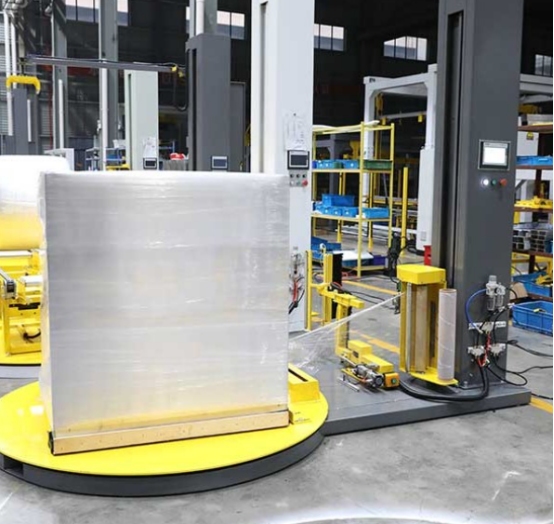
Why Should You Trust Stretch Film Manufacturers for Your Packaging Needs
FAQ
What is your minimum order quantity (MOQ)?
Can I request samples before placing an order?
What are your typical lead times and shipping options?
Get a Free Quote